
Multi-Block-Attention-based Color Constancy
Oguzhan Ulucan, Diclehan Ulucan, Marc Ebner
European Conference on Computer Vision (ECCV 2026), Malmö, Sweden
Abstract
Color constancy algorithms estimate and remove the effect of the illuminant from a captured image, enabling consistent color perception under varying illumination conditions. Learning-based methods achieve high accuracy but tend to be biased toward the spectral characteristics of training cameras. Traditional algorithms such as white-patch Retinex are computationally efficient and camera-independent, but underperform when scene statistics deviate from their assumptions. Therefore, in this paper, we propose a hybrid approach that combines classical assumptions with learned features. Our model processes images in a block-based manner through two complementary branches. The backbone branch extracts scene features and identify reliable regions for illuminant estimation. Guided by these saliency maps, the statistics branch computes per-block illumination priors using a soft maximum formulation that provides a differentiable approximation to the classical white-patch Retinex. Features from both branches are fused and refined through multi-head self-attention, which enables blocks to exchange information across the image, addressing the aggregation bias common to block-based methods. Experiments on five benchmarks demonstrate that our model achieves state-of-the-art performance with a compact architecture (1.1 MB) that requires no camera-specific calibration or metadata.
HYBRID CC
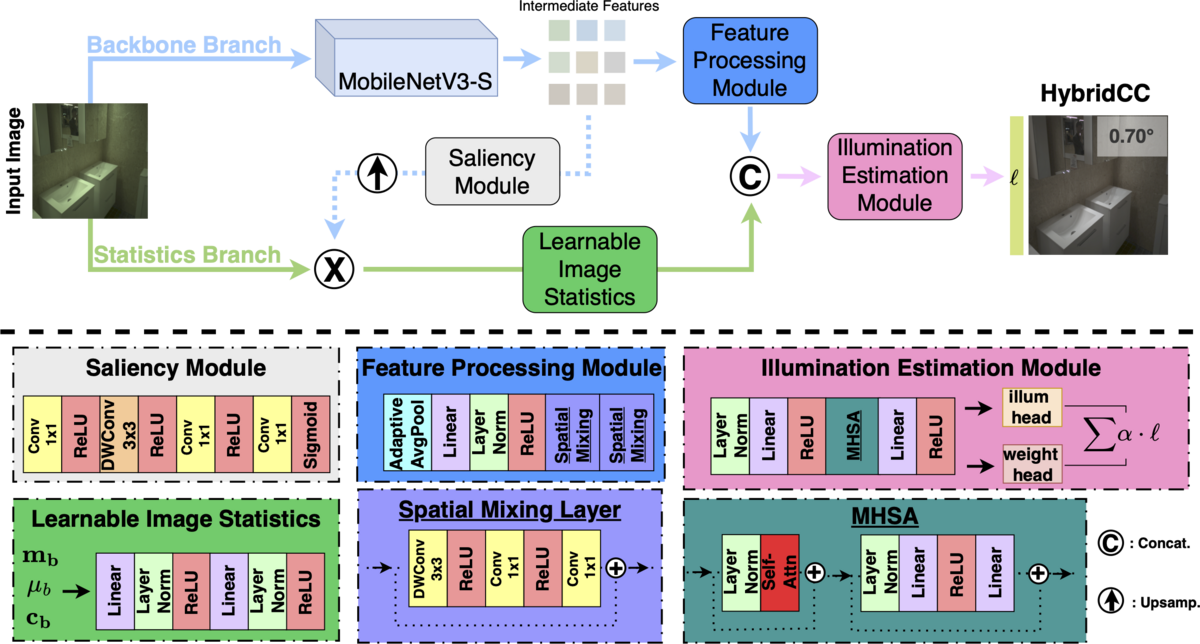
We propose a hybrid model that processes images block by block through two complementary branches. We use a saliency-weighted soft maximum, learned end-to-end, which acts as a differentiable approximation of white-patch Retinex. We then refine the per-block estimates with multi-head self-attention, allowing any block to attend to any other regardless of spatial distance. This lets unreliable blocks in dark or shadowed regions benefit from illuminant cues in well-lit, chromatically informative regions elsewhere in the image. This is the first use of self-attention for the block aggregation bias in color constancy.
Results
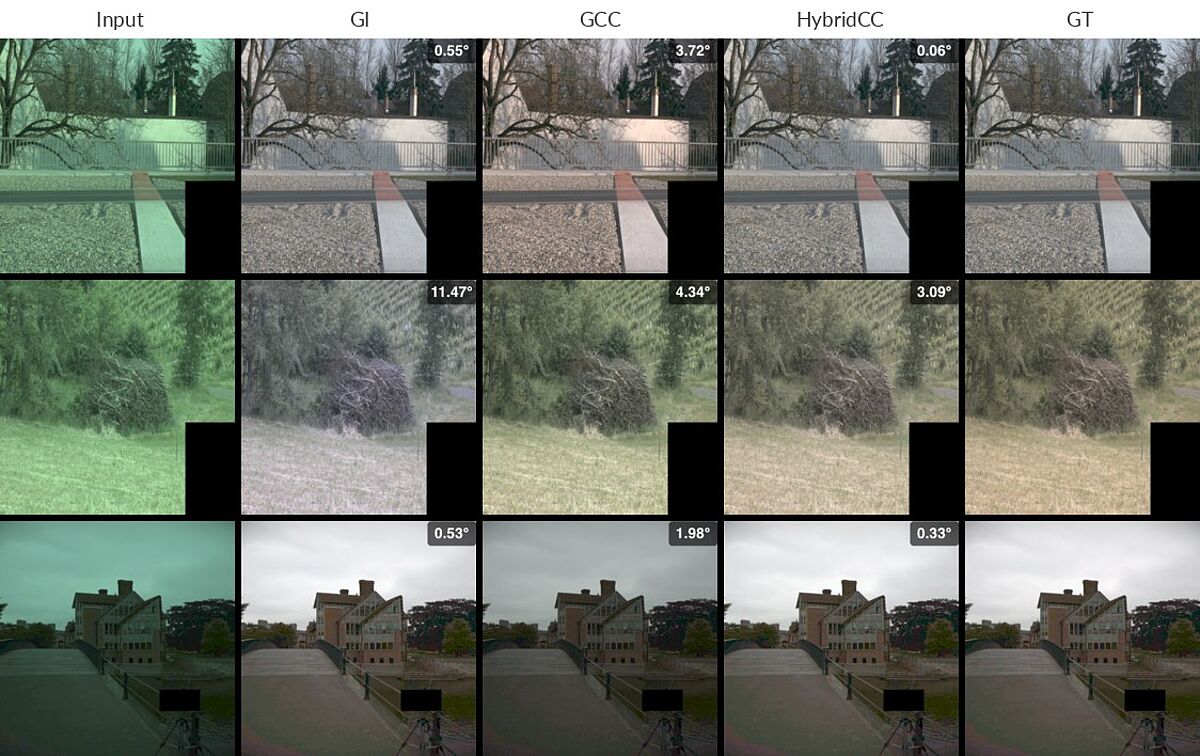
The model is evaluated using a leave-one-dataset-out strategy, together with a cross-sensor protocol.
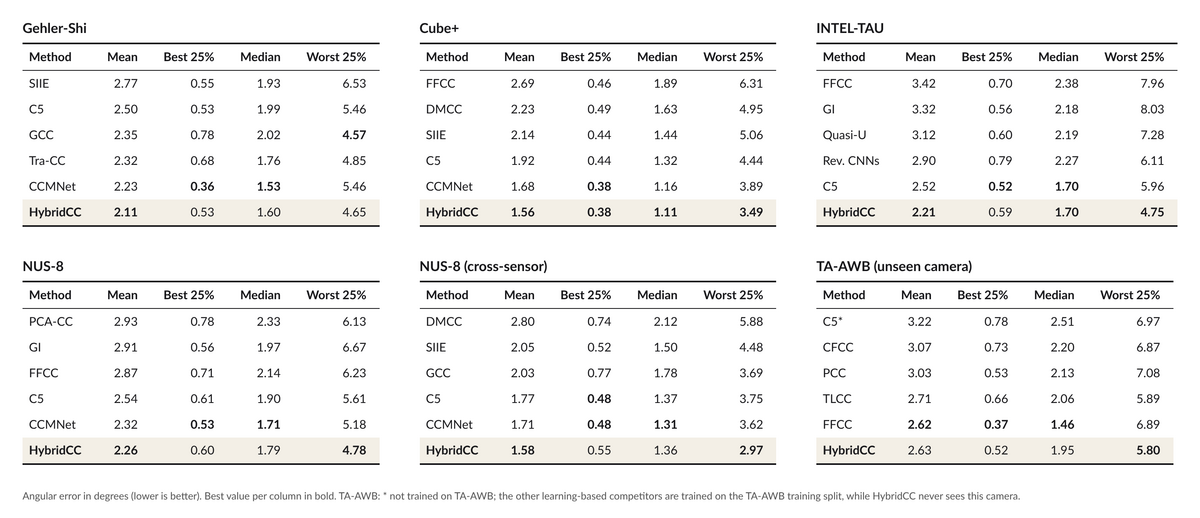
Our model achieves the lowest mean angular error on Gehler-Shi, NUS-8, Cube+, and INTEL-TAU, as well as on the NUS-8 cross-sensor protocol, improving over the closest prior SOTA by 8% mean error and by up to 18% on the worst-25% cases.
@inproceedings(ulucan2026multi,
title = "Multi-block-Attention-Based Color Constancy",
author = "Ulucan, Oguzhan and Ulucan, Diclehan and Ebner, Marc",
booktitle = "European Conference on Computer Vision",
pages = "645--663",
year = "2026",
organization = "Springer"
)